Showing posts with label Indian recipes. Show all posts

Friday, 25 October 2013

Comfort Food - Tenga Dal

UK should definitely register its Winter Flu as a certifiable weapon of mass suffering. Every year, come September, there is a deluge of cold and flu sufferer sniffling and sneezing their way through life. I myself have suffered through a particularly bad one last year which lasted for 18 miserable days. Apparently there was a bad viral strain doing the rounds last year. This year, it was my husband's turn to  suffer, and when you are sick, your taste buds off, nothing feels better than some good old comfort food. Comfort food by definition is a bit tricky, it depends on geography, family traditions and most importantly, taste buds. For example, my grandmother's roast chicken is the ultimate comfort food for me. An awesome dish, but a bit tricky to make when you have a fever. So since last year, I have been making my own comfort foods, borrowed heavily from my grandmother's cooking. A taste of the home but with no fuss.

First up is the Tenga mogul dal, or lentil soup. Nothing else will do for me when I have a running cold. Like all comfort food, this one too has a story. In Assam, lemon or lime also known as Kaji Nemu is an essential part of your lunch or dinner experience. The Kaji Nemu especially has a most aromatic smell and for me it is the most exotic accompaniment to any dish. When I was a child, this was often made at home with the fruit and the leaves used from our own lime tree in the back yard. I have since jazzed it up a bit for a bit more grown up version. Depending on your larder, this will either be kitchen essentials or something warranting a special shopping trip. For me its the former, so its an easy dish to cook.


What you will need

1 cup dal (you can use mogu or mosur)
A slice of lemon
1 stalk of lemon grass
A couple of frozen lime leaves (I get this from a local Chinese store, its not Kaffir leaves, just regular lime leaves. Although you can use Kaffir leaves as well)
Green papaya (optional)
1and 1/2 teaspoon regular cooking oil
Panch phuran or kalonji (optional)
Garlic


I rinse the lentils once and put it in a pan with 2 cups of water, papaya and lemon, lime leaves and lemon grass (also sliced into 1 inch pieces). I put this on medium heat, lid on for about 20 minutes. If you are worried about the water boiling over then partially cover the pan. After 20 mins, the lentils should be soft enough. Give the whole thing a good stir. This ensures that all the flavours get meshed in well.


If you want, you can fish out the lemon now and add a little water if you prefer a more soupy texture. The magic ingredient is actually the lime leaves, the moment you add this, this dal becomes a show stopper.


At this point I generally decant the cooked lentils into a bowl and in the same pan add the oil and panch phuran or nigella seeds and garlic. Once the seeds start popping, I add the lentils back in and season with salt as per taste. And your dish is ready. For me, the lemon and lime combo is a bit of heaven when I am down in the dumps.


Thursday, 8 August 2013

Traditional cooking: sambhar

One of my favourite dishes to cook is the Sambhar which is a south Indian lentil dish. I make this on days when I want to have something tangy and comforting while vegetating in front of the telly. This is a pass it down recipe from my mother which I have simplified to a great extent. I am dividing the ingredients into two To make this dish you need:

Basics
Toor or Arhar dal (available in all supermarket stores)
Vegetables of your choice
Cooking oil

Spices/eastern goodies
Asafoetida
Coriander seeds (whole)
Dry chillies (whole)
Fenugreek seeds (whole)
Curry leaves (you can get fresh leaves at most indian stores. In a crux you can use the dried leaves)
Tamarind (I soak just a bit more than a quarter of tamarind in 1/2 cup of water for about 20 minutes. I take out the seeds before using it. If you want to be more fancy then you can strain the liquid and get rid of all the roughage.)


For starters I soak a cup of Toor Dal for a good 2 hours, this softens the lentils and washes away artificial colouring and other impurities. I then wash it once and bung the lot into a pressure cooker. Its of course a known fact that every Indian owns a pressure cooker. Mine is on its last leg, but there's no denying the fact that it halves the cooking time for most Indian dishes. If you don't own a pressure, then just use your normal pan. Now then, back to the recipe. For every cup of dal, I add about 21/2 cups of veggies. You can use whatever vegetables you want, but if you want a bit of exotic going on then I would recommends adding okra (found in larger Tescos/ indian stores), and drumstick (found only in Indian stores).

My favourite vegetable combo for this dish are tomatoes, aubergines, okra, drumstick, onions and carrots. I roughly chop the veggies, add it to the cooker along with 2 cups of water, put the lid on and two whistles later your dal is done.


Now comes the fun part. In a hot pan, roast the coriander seeds, fenugreek seeds and dry chillies for about a minute. Alternatively, you can use the microwave for this. Just be careful with the time otherwise you will end up with burnt instead of aromatic spices. I roughly grind the roasted spices in a mortar and pestle (you can use a dry grinder) and put aside for later. In the same pan, I add about a tablespoon of cooking oil and when the oil heats up I add half a teaspoon of Asafoetida. The Asafoetida does a fizzing thing, don't be alarmed by it, its supposed to happen. I add a generous handful of curry leaves, 1/2 teaspoon turmeric powder for colour and sometimes a few fresh chillies to make it extra hot.


I then carefully pour the tarka onto the cooked dal and veggie mix, add the tamarind water (sans the seeds), the roasted spices and salt. Have a taste and if you are happy with it, then its good to go. Sometimes if I find it too tangy, I add a pinch of sugar just to balance it out. Before serving I garnish the dish with some more of my roasted spice mixture.


Best served with a bowl of rice or if are a whiz, then dosa. Happy eating.

Thursday, 1 August 2013

Traditional cooking-Iilsh maasor jhol

I was talking to one of my very dear friend Richa today. Now Richa and I have been friends for about 10 years now and its one of those friendships that you know will see you through this lifetime. So anyways, while I was talking to her I mentioned that nowadays I am quite a decent cook. And that I can cook fish. Coming from me that is a big deal. When Richa and I lived together, we were know for our lack of cooking skills. To be fair, Richa was worse than me. Her only job was to wash and cut the coriander for the salads. And she took her own sweet time doing it. Most of the cooking was done by Izeule (my other flatmate) a formidable one woman cooking-cleaning machine. So its been ten years, but I have finally managed to get down and dirty with my pots and pans in the kitchen.

My most recent culinary dish was to try one of my grandmother's fish recipe, Ilish maasor jhol. My granny is a legendary cook in her part of the world so after a lot of copious note taking over the phone, I recreated the dish and presentation aside, I nailed it. Part of it was due to the fish itself and mustard and Ilish is a heavenly combo like roast and potatoes, lamb and mint, scones and cream, oh I could go on. I find the ilish very like the Salmon, as in they are both anadromous species (born in fresh water, migrates to the sea and returns to fresh waters for spawning). They are both very popular food choices and they are both very tasty. The only difference is that the Ilish is full of tiny bones, so you need to be careful while enjoying it. In the UK you can get frozen Ilish in any decent Bangladeshi food store. I get mine sliced and diced at the store and put the slices in cold water to thaw before the hubby can get to cleaning the gut. And no, I haven't got down to cleaning the fish. its early days yet for this cook.

Before making the jhol, you need to fry the fish. At least that is how we do it in Assam. So once the fish is cooked and cleaned, I mix it in with some turmeric and salt (about a teaspoon each). I put about 2 tablespoon of good quality mustard oil, not the refine/mustard mix which is sold as pure mustard oil in Tesco. Wait till the oil is very hot before adding the fish, otherwise it will break or absorb too much oil.


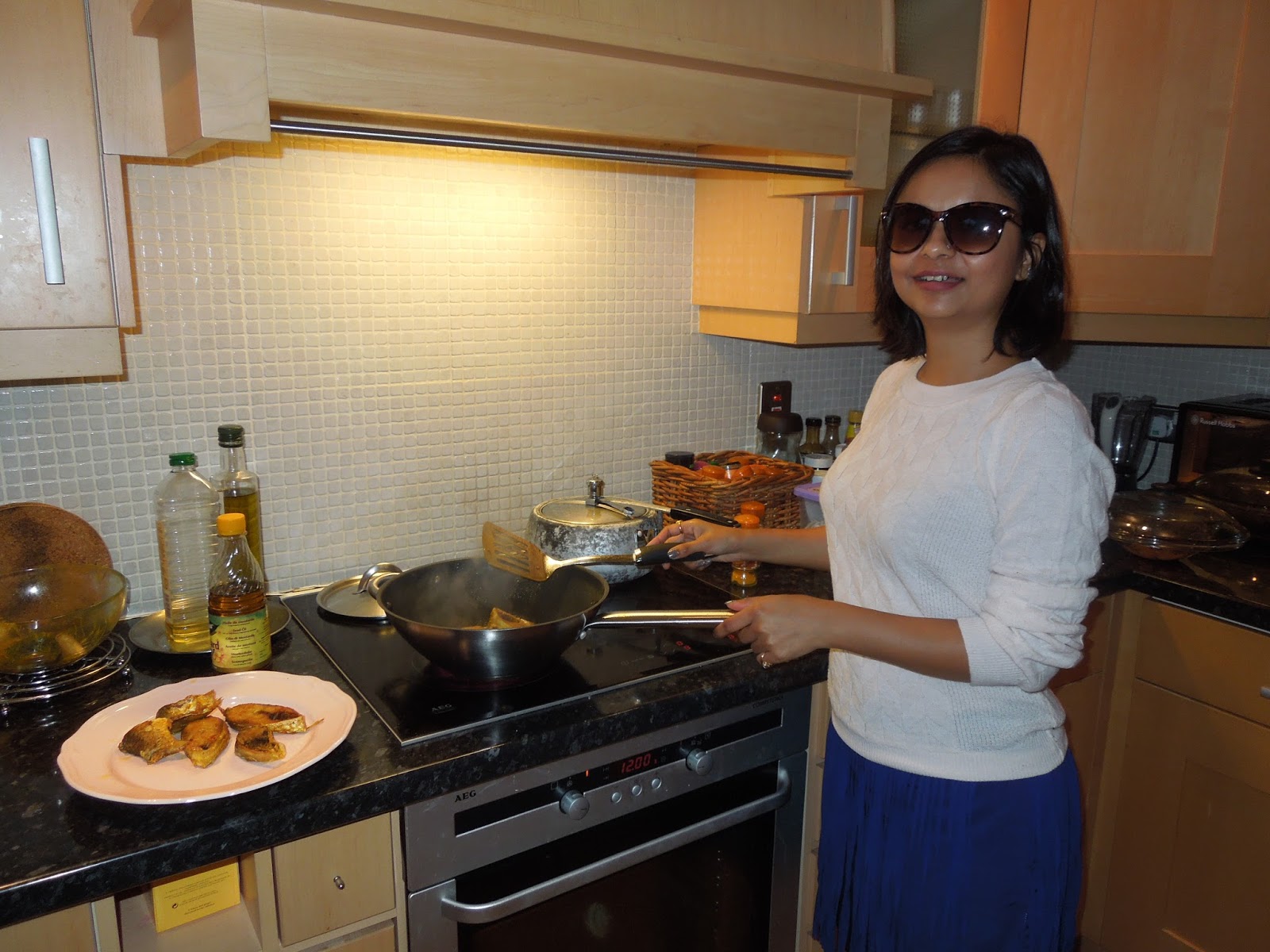
I fry about 4 to 5 pieces at a time, so it all depends on the size of your pan really. About 2 minutes on both sides makes the fish nice and golden. The trick to frying fish is to do it with your sunnies on and a bottle of Sudocream at hand because chances are that you will get hit with hot oil. I look something like this when I fry these bad boys.


Now for the jhol, I make a yellow mustard seed paste. I soak 3-4 teaspoons of yellow mustard seeds in water for about 20 minutes. I make a rough paste of this on my mortar and pestle. You can also do it in a blender, grinder what have you.


In the oil left in pan (after frying the fish), I add two finely sliced onions, some dry chillis and a teaspoon of dry chilli powder for extra zing. I fry this till the onions soften and then add the mustard paste to the mix. I continue frying and add a little water so that the mixture doesn't get burned. After about ten minutes of frying, the onions and the mustard would emulsify into a golden-red paste (this would take about 7-9 minutes of frying).


I then add a cup of water (about 250 ml) and put the fish back in to the pan. Lower the heat and put the lid on for the fish to cook. The fish gets cooked in about 10 minutes. I then season it as per taste and because I have a heat index of 9/10, I garnish the dish with fresh red chillies and raw mustard oil before serving.


Serving suggestion: Works best with chilled Desperadoes and cooked basmati rice. And yes no forks, unless you want to choke to death on fish bones. Use your hands. Seriously.